



REVESCO. Revista de Estudios Cooperativos. ARTÍCULOS
e-ISSN: 1985-8031
Sofía Arana Landín
Universidad del País
Vasco (UPV/EHU) (España) 

https://dx.doi.org/10.5209/REVE.94850 Recibido: 07/08/2023 • Aceptado: 26/02/2024 • Publicado: 18/03/2024
ES Resumen. La meta 12.3 de la Agenda 2030 de las Naciones Unidas (ONU) es la siguiente: "Para 2030, reducir a la mitad el desperdicio mundial de alimentos per cápita a nivel de minoristas y consumidores y reducir las pérdidas de alimentos a lo largo de las cadenas de producción y suministro, incluidas las pérdidas posteriores a la cosecha." La implementación de las metas específicas de la Agenda 2030 de la ONU, como ésta, supone un reto importante, ya que requieren acciones inmediatas, políticas públicas adecuadas y una colaboración sin precedentes entre entidades privadas, públicas y países. La meta 12.3 está intrínsecamente relacionada con muchas otras metas, por lo que su consecución tiene un impacto directo en varias de ellas. Por lo tanto, es vital alcanzarla con éxito, no sólo para reducir el hambre, sino también para lograr muchos otros objetivos de la Agenda y, en particular, para poder reducir nuestra huella medioambiental.
La Prevención de Pérdidas y Desperdicios de Alimentos (FLW) es un objetivo dentro de la Economía Circular que puede considerarse central, ya que el objetivo 12.3 trata de prevenir la sobreproducción de alimentos con una mejor redistribución que no sólo reduzca los insumos, sino que también intente minimizar los desperdicios mediante la donación de productos alimentarios a entidades de la Economía Social (ES) que ayudan a los más necesitados.
Dado que la Economía Circular contribuye a la resolución de los tres problemas ambientales más acuciantes: la sobreexplotación de recursos, el calentamiento global y la pérdida de biodiversidad, además de todos los impactos negativos derivados de estos (ONU Medio Ambiente, 2019) prevenir las pérdidas y desperdicios de alimentos es también clave para asegurar la solución tanto de un profundo problema social, como de salud pública, además de los más importantes problemas medioambientales.
A pesar de que resulta evidente la urgencia de una acción inmediata, diversos académicos, como Martín Río, Rogenhofer y Sandoval Alvarado (2022), destacan que la atención que este objetivo recibe por parte de la doctrina sigue siendo escasa. Por ello, el propósito de este trabajo es comparar estas políticas a ambos lados del Atlántico, proponer recomendaciones y ayudar a concienciar sobre el problema de las pérdidas y el desperdicio alimentario, siguiendo un enfoque holístico para todos los posibles actores implicados, ya que la comunicación es fundamental para alcanzar este objetivo. En este trabajo se presta especial atención a las políticas fiscales en los casos en los que se donan alimentos a Entidades de Economía Social como bancos de alimentos, fundaciones sin ánimo de lucro o comedores sociales, ya que los tributos pueden actuar como barreras o como facilitadores para alcanzar este objetivo; por lo tanto, es crucial aplicar las políticas tributarias correctamente para garantizar que actúan como verdaderos facilitadores. Así, podremos evaluar los cambios fiscales que pueden ayudar a conseguir el objetivo mediante una comparación entre las políticas fiscales existentes en Estados Unidos y la Unión Europea.
Palabras clave. Donaciones, entidades sin ánimo de lucro, bancos de alimentos, pérdidas y desperdicio alimentario, políticas fiscales.
Claves Econlit. H30, H23, D64, Q58, Q28.
ENG Tax measures to reduce food losses and waste in the United States and the European Union: a comparative analysis
ENG Abstract. Target 12.3 of the United Nations (UN) 2030 Agenda is as follows: “By 2030, halve per capita global food waste at the retail and consumer levels and reduce food losses along production and supply chains, including post-harvest losses.” The implementation of the specific targets of the UN 2030 Agenda, such as this one, presents a significant challenge, as they require immediate action, proper public policies, and unprecedented collaboration between private and public entities and countries. Target 12.3 is intrinsically related to many other targets, so its achievement has a direct impact on several of them. Therefore, it is vital to successfully achieve it, not only to reduce hunger but also to achieve many other Agenda targets and, in particular, to be able to reduce our environmental footprint.
Preventing Food Losses and Waste (FLW) is a target within Circular Economy that can be considered to be most instrumental as Target 12.3 tries to prevent food overproduction with better redistribution that not only reduces inputs but also attempts to minimize waste by the donation of food products to Social Economy (SE) entities that help those in need. Circular Economy contributes to the resolution of the three most pressing environmental problems: overuse of resources or overexploitation, global warming, and biodiversity loss, in addition to all the negative impacts derived from these (UN Environment, 2019), preventing food losses and waste is also key to ensure the solution of both a deep social problem a public health one and the most important environmental ones.
Even though the urgency of immediate action is clear, various academics, such as Martin Rio, Rogenhofer, and Sandoval Alvarado (2022), highlight that the attention this target receives from professionals remains scarce. Therefore, the purpose of this paper is to compare these policies on both sides of the Atlantic, to propose recommendations, and to help raise awareness of the problem of FLW, following a holistic approach for all possible actors involved, as communication is critical to achieve this target. Special attention is paid regarding tax policies in cases where food is donated to Social Economy Entities such as food banks, non-profit foundations, or soup kitchens as taxes can both act as barriers or facilitators to this aim; therefore, it is crucial to implement them correctly to ensure they act as true enablers to achieve the target. Thus, we will be able to assess the tax changes that can help do so by means of a comparison between the existing ones in the United States and the European Union.
Keywords. Donations, non-profit entities, food banks, food loss and waste, tax policies.
Summary. 1. Introduction. 2. Public policies to promote private entities to help achieve the targets of the 2030 Agenda. 3. By 2030, halve per capita global food waste at the retail and consumer levels and reduce food losses along production and supply chains, including post-harvest losses as a particular mission. 4. The Shift towards a Circular Economy regarding Target 12.3. 5. What are the alternative uses? The food recovery hierarchy. 6 Tax policies to achieve the target. 7. Conclusions. 8. References.
How to cite: Arana Landín, S. (2024). Tax measures to reduce food losses and waste in the United States and the European Union: a comparative analysis. REVESCO. Revista de Estudios Cooperativos, 146(1), 1-15, e94850. https://dx.doi.org/10.5209/REVE.94850.
The European Union (EU) wishes to play a leading role in reducing food waste (FW). It has implemented legally binding targets (reduction by at least 30% by 2025 and 50% by 2030) in Directive 2018/851/EU, of 30 May 2018, amending Directive 2008/98/EC on waste and the EU Farm to Fork Strategy, for a fair, friendly and environmentally friendly food system[1].
As for the United States, it has implemented the U.S. 2030 Food Loss and Waste Reduction Goal, to halve food loss (FL) and food waste (FW) by 2030.
However, despite food loss and waste (FLW) being a global issue and a specific and most instrumental target in the United Nations (UN) 2030 Agenda, just 28% of countries have a dedicated FW strategy. There is therefore an urgent need for nations to develop national strategies to reduce FLW, aligning public policies with the private sector, producers, and consumers.
Regarding the indicators used in the EU to measure the advances in the attainment of the target, the so-called “SDG indicator set,” these are reviewed on an annual basis. The indicators for the 2022 report were reviewed for their alignment with the EU’s 8th Environment Action Program and the new targets of the European Pillar of Social Rights Action Plan. The achievement of Target 12.3 of the 2030 Agenda also coincides with these instruments. Therefore, they can be said to form an ecosystem, whereby helping to attain one helps to achieve the others as the efforts to tackle food sustainability also help address other key social and economic objectives, such as human and sustainable development.
Meanwhile, in the United States, the target is the same, the indicators to achieve it are very similar, and even the food hierarchy mainly coincides with the one in the EU. Moreover, the nutritional challenges faced by these high-income countries compared to middle-to-low income countries are also similar as overconsumption and overweight are common problems at both sides of the Atlantic. However, the public policies appear to follow a slightly different direction.
Meanwhile, non-economic financial disclosure has become instrumental for companies, meaning they have to respond to disclosure requirements about different environmental and societal goals, such as the reduction of greenhouse gas emissions (GHGE) or waste management; a good FW strategy has a positive impact on both. Therefore, reducing FW is not only a goal for public entities but it also involves private ones.
As we will see, Social Economy entities, such as soup kitchens, food banks and other forms of SE (Fernández-Guadaño & Montes Diez, 2023) have a critical role tor the attainment of the goal.
To begin, a definition of “public policy” must be given. Following Wolf (2005), it can be defined as follows: “the course of action or inaction taken by government with regard to a particular issue or set of issues.” Therefore, the concept of public policy encompasses economic, social, and environmental policies, which share most of its characteristics (Vaillancourt, 2009). Public policies are necessary at all levels (municipal, regional, statewide, supranational and international). Above all, international bodies such as the United Nations have set the Agenda with priorities, which state that supranational structures[2], such as the federal US government and the EU, need to take the lead with a framework for public policies to help States, regional authorities, and municipalities take action to achieve targets such as target 12.3 of the 2030 Agenda. For this purpose, regulatory change becomes essential if we are to achieve or even move in the right direction to achieve the target. The goals and targets are now set for the 2030 Agenda, but, as Krugman (2023) highlights regarding climate change: “ultimately the government is going to have to take the lead.”
Therefore, the first conclusion to make is that supranational governments (such as the European Union and federal legislators in the United States) as well as other actors such as States and municipalities must end the inaction that has led us to approximately 40% of FLW in the United States and approximately 20% in the EU[3]. It should be remembered that these percentages are higher than the global average, making the achieving of the target even more urgent in these two continents[4].
Therefore, public policies should be set in the right direction—that of the 2030 Agenda—so that others will follow. It is extremely important to ensure a certain uniformity in policies, and these supranational entities can help achieve it, as standardized policies can be very useful for avoiding confusion in retailers and consumers.
If municipalities, counties, regions, and states enact very different policies, this causes uncertainty and can be an additional barrier to FLW. This is the reason why it is necessary to advocate for at least codes of conduct by international or supra-national entities that can guide others with clear and preferably uniform policies whenever possible. We are aware that competence in the matter may be an issue, as different levels of government may have different input and may consider the guidelines a possible intrusion, but they should, at least, attempt to follow a general pattern for the common good. This has been successfully achieved in the United States by the design of the Food and Drug Administration (FDA) Food Code. Even though this code is not binding on all States, for instance, DC has followed it as a model for their own laws, thus achieving a certain uniformity in the matter.
Regarding the manner in which it should be done, it should be that of a mission; a collective goal—a common task where States, regional authorities or municipalities attempt to set the arena with the necessary instruments for the policies to be successful and private entities, civil society, and others play an important role in making the mission their own[5]. As Mazzucato (2014) explains: “in innovation, the State not only ‘crowds in’ business investment but also ‘dynamizes it in’—creating the vision, the mission and the plan”. Furthermore, President of the European Commission Ursula Von der Leyen also referred to Apollo 11, the mission of sending the man to the moon, when launching the funds for the green transition. Manfredi (2021) also underlines the wisdom of considering the form of ”mission” as "the mission is the most appropriate planning instrument." It is clear that the period of attempting to achieve these targets simply by voluntary measures has passed, as we have not achieved any particular progress in the right direction. We now have to move under pressure, via compulsory measures that enhance the target. Regarding Target 12.3, the UN Food and Agriculture Organization (FAO) stated the following in its 2022 report: “This year’s report should dispel any lingering doubts that the world is moving backwards in its efforts to end hunger, food insecurity and malnutrition in all its forms. We are now only eight years away from 2030, but the distance to reach many of the SDGs targets is growing wider each year. There are indeed efforts to make progress towards SDG 2, yet they are proving insufficient in the face of a more challenging and uncertain context.”
However, getting it right from the very beginning, or at least with some time to be able to adapt, becomes crucial as it is not only a question of adopting public policies but of choosing the right ones. This is why this paper focuses on different policies as regards Target 12.3; the ones set at a federal level in the United States and at a supranational level in the EU, as in both cases they can lead the way for a large number of States, regional entities, and even municipalities. The target is clearly set and the indicators are fair and already there; the next logical third step, therefore, is to promote the attainment of the target by setting incentives through public policies that can help us achieve it in a collective manner. The effect should be symbiotic.
This target is analyzed here because achieving it should be a major cause of concern for all manner of social, environmental, and health reasons. As Krugman (2023, p. 14) explains regarding food crises: “What I am really very concerned about is the global food crisis. I am very concerned that there could be famines linked to the food crisis.” We cannot afford to be this inefficient regarding something as basic for human society as food. Moreover, it is not only a question of extreme inequality and danger of famine; FLW also damages the ecosystem and its resilience in the long term, as they are in a synergistic relationship. Furthermore, FLW not only jeopardizes the achievement of this specific target but also those of several Sustainable Development Goals (SDGs) in the 2030 Agenda as they are a source of GHGE. As Martin-Rios, Rogenhofer, and Sandoval Alvarado (2023, p. 190) note: “paradoxically, global indicators do not show progress in reducing their causal factors. Food waste is a global issue and a major challenge aggravated by its role in climate change, land, water, and biodiversity scarcity, groundwater pollution, and global deforestation.”
The food system must be sustainable and it is a major issue that only 6 years before the 2030 deadline, this goal remains unachieved as, according to the report by the UN FAO (2022) on FLW, approximately one-third of all food produced globally is lost or wasted[6]. This means we are following practices that not only result in poor health and deaths for too many people, but are also environmentally destructive policies as when food becomes waste, it causes GHGE. Moreover, producing food that is not going to be consumed contributes in a number of ways to climate change as, in addition to GHGE, it causes deforestation and important hydric losses (FAO, FIDA, WHO & UNICEF, 2022[7]). As The US Environmental Protection Agency (EPA) reports, FW alone was the largest component in landfilling, totaling approximately 24.14% [8].
Therefore, achieving Target 12.3 is a significant challenge as it is an inefficiency with an extremely high impact on several SDGs[9]. At the same time, it is a goal of responsible consumption and production, so its circularity measures to avoid FLW can most certainly make a difference.
First, therefore, the different concepts involved in this target must be outlined. Regarding the concept of food, in the case of the EU, the definition of “food” laid down in Regulation (EC) No 178/2002 of the European Parliament and of the Council comprises food as a whole, along the entire food supply chain from production until consumption, including inedible parts where those were not separated from the edible parts when the food was produced, such as bones attached to meat destined for human consumption. Hence, FW can comprise items including parts of food intended to be ingested and parts of food not intended to be ingested. Importantly, the concept of FLW does not include losses at stages of the food supply chain where certain products have not yet become food, such as edible plants which have not been harvested. This means that the statistics of FLW fall short as FLW can be considered to include more. It is therefore time to expand the scope of FLW measurement and include edible food left unharvested or used on farm at primary production if FLW is to be prevented and reduced along the whole food supply chain. In fact, for many reasons, such as aesthetic ones, perfectly edible food is left on the trees or fields to rot. In this sense, the initiative of the Espigadors in Catalonia, which represents a form of non-profit gleaning, is an excellent candidate to be considered in other places[10]. It consists of people who, with the owner’s consent, take food directly, usually for food banks or other non-profit entities. In this manner, the food (that does not even count in the statistics) is not lost or wasted. There are actually regulations for gleaning in the laws of the government of Catalonia.
Regarding the concept of FLW, both concepts have been studied by academics, whereby both FL and FW refer to edible materials that are subsequently discharged, lost, degraded, or contaminated, so that they are not finally eaten, becoming waste.
It should be highlighted that the food supply chain is a long one that begins with food production, mostly in the agricultural or fishing sectors, where waste, either organic such as manure or inorganic, is produced for different reasons (aesthetic reasons, damaged harvests left to rot, products that for different reasons are not demanded, etc.). There are also losses at the stage of food processing and at the manufacturing industry due to a variety of circumstances such as deficient transport or storage, processing, or packaging. Parfitt, Barthel and Macnaughton (2010) also note the waste produced at the retail phase, mainly due to deficient conservation or handling, and lack of cooling/cold storage[11]. Finally, the percentage of FW the end consumer also incurs in the last phase is significant, amounting to approximately 17% in the United States and the EU, due to various different reasons such as over- purchasing, deficient storage conditions, preparation, portioning, and cooking.
The EU has also highlighted the important factor of the widely spread confusion between the terms “best before” or “use by” dates. Thus, the European Commission has proposed to revise the rules on date marking as set in Annex X to Regulation No 1169/2011, on the provision of food information to consumers to prevent the unnecessary discarding of food. This decision is part of the EU’s From Farm to Fork strategy, following a study within the Circular Economy Plan carried out by the European Commission (2018) that estimated that up to 10% of FW generated annually in the EU was linked to date marking.
Therefore, it is important to note that even though the term FLW is used, it refers to different phases in the food chain, and FL and FW even have different indicators and respond to very different causes. It can be summarized by noting that FL occurs within the production or primary cycle in its first phases before marketing, whereas FW occurs from the marketing of food onwards, including waste generated in households.
In 1981, the FAO defined FL as any change in the availability, edibility, wholesomeness, or quality of edible material that prevents it from being consumed by people, without any further reference to the food supply chain. However, decades later, Gustavsson, J., Cederberg, C., Sonesson, U., (2011), specified the inclusion of the production stage of a food supply chain and not only the postharvest and processing stages, stopping FL from being restricted to that first part of the chain[12]. This consideration was followed and complemented Parfitt et al.’s (2010) definition of FW as the food loss occurring at the retail and final consumption stages; therefore, its generation became related to the second part of the food chain—to retailers’ and consumers’ behavior. In this manner, FL refers to the first stage of the food chain whereas FW refers to the final stage.
Moreover, this difference between the two is assumed in practice by the UN, as FL and FW are not monitored by the same UN Agency and do not use exactly the same indicators. Thus, the FAO is the organisation responsible for monitoring FL at the global level and does so through the Agenda 2030, 12.3.1 indicator. This includes food losses in planting, harvesting, storage, transport, distribution, processing, and packaging, before the food product reaches the commercial sector[13]. For the purpose of monitoring, the FAO has designed a voluntary Code of Conduct addressed to national and sub-state authorities in each country, different agents in the food supply chain, the private sector, producers' organizations, civil society, etc. Therefore, it is a guide that supranational governments should consider for the design of public policies concerning FLW.
As for FW, the United Nations Environment Program (UNEP) is in charge of its measurement through the 12.3.2. indicator[14]. This indicates the importance FW also has for the environment and the Circular Economy (CE)[15]. This indicator measures FW at the next stage, from the time food reaches the commercial sector, understanding such waste as those agricultural and food products discarded from the food chain that are still perfectly edible and suitable for human consumption and which, in the absence of possible alternative uses, are ultimately discarded as waste.
However, it should be noted that Östergren et al. (2013) do not make this difference as they define FW as “any food, and inedible parts of food, removed from (lost to or diverted from) the food supply chain to be recovered or disposed (including composted, crops ploughed in/not harvested, anaerobic digestion, bio-energy production, co-generation, incineration, disposal to sewer, landfill or discarded to sea.” Therefore, the authors do not focus on the different phases in the food supply chain or the different UN agencies monitoring FL and FW, or even on the different indicators for FL 12.3.1 and FW, 12.3.2. Instead, they consider FW to be any food that, even though produced for human consumption, has left the food supply chain, no matter the phase in the supply chain it left. In addition, they consider organic materials produced for the non-food production chain as not included in FW. However, this paper argues that the fact there are different indicators and agencies to monitor FL and FW is sufficient to understand the differences of both concepts.
FL and FW generation has an impact at an environmental, social, and economical level. From an environmental perspective, FL and FW contributes to GHGE during final disposal in landfills (uncontrolled methane release) and during activities associated with food production, processing, manufacturing, transportation, storage, and distribution. Other environmental impacts associated with FL and FW are natural resource depletion regarding soil, nutrients, water, and energy; disruption of biogenic cycles due to intensive agricultural activities, and all other characteristic impacts at any step of the food supply chain (FSC). The social impacts of FL and FW may be ascribed to the ethical and moral dimension within the general concept of global food security. Economic impacts are due to the costs related to FW and their effects on farmers and consumer incomes, as stated by Lipinski et al. (2013).
Although the EU’s regulation dates from 2002[16], there have been many instances in which legislators have attempted to urge for stricter and binding public policies to help reduce FLW. However, the focus regarding food is always more focused on safety and hygiene. Of course, setting the right safety and hygienic standards is crucial, but if those are too strict and the singular focus of legislation, then they can become an obstacle to the reduction of FLW as they represent a serious barrier for food donations to SE non-profit entities. Unfortunately, it appears that an extremely strict policy on safety and hygiene has impeded many food donations to food banks, soup kitchens, and others because of the importance of responsibility in the hypothetical cases in which the possible food to be donated may present a hygiene or safety liability after its donation to SE entities. This lack of exemption of liability in the cases of perfectly edible food being donated to SE entities has been a serious problem that should have been tackled to promote food donations in the EU. However, although in 2012, the European Parliament called on the Commission “to take practical measures towards halving food waste by 2025” including “specific food waste prevention targets for Member States,” they failed to answer the question of the policy of liability as regards food donations.
In the EU, Directive 2008/98/EC obliges Member States to include FW prevention in their waste prevention programs and to monitor and assess the implementation of their FW prevention measures by measuring the levels of FW on the basis of a common methodology. The Commission was to establish that common methodology and set out minimum quality requirements for the uniform measurement of levels of FW on the basis of the outcome of the work of the EU Platform on FLW. Although the Directive dates back to 2008, there is an “after” and a “before” due to the “Farm to Fork strategy,” which is within the European Green Deal regarding FLW. From this strategy onwards, more concrete measures are being adopted, such as Delegated Decision 2019/1597 EC, which establishes that as of 2022, Member States in the EU are obliged to report on FW reduction efforts regarding base year 2020. This is crucial, as to do so, Member States need to measure FLW and implement their own policies to halve it. This is an initial step in making MS adopt the right public policies to reduce it, adopting this requirement as if it were their own.
An important EU date in this regard is 2018 when, in the context of the revision of the Waste Framework Directive, a legal obligation for EU Member States to measure their food waste from 2020 onwards was introduced. From that date, Member States need to report their own FLW to the Commission. It also obliged the Commission to examine this FW data, with a view to “considering the feasibility of establishing a Union-wide food waste reduction target to be met by 2030 on the basis of the data reported by Member States” by 2023. This is an important step as Member States need to measure and report FLW and agree to adopt measures to reduce FL and halve FW by 2030. However, it should be noted that the question of tackling the important issue of liability as regards food donations to SE non-profit entities remains off the table.
As the types of FW and the factors contributing to the generation of FW differ significantly between the different stages of the food supply chain, FW should be measured separately for each stage. It is regulated in Commission Delegated Decision (EU) 2019/1597 of 3 May 2019 supplementing Directive 2008/98/EC of the European Parliament and of the Council as regards a common methodology and minimum quality requirements for the uniform measurement of levels of FW. This text considers food as “any substance or product, whether processed, partially processed or unprocessed, intended to be, or reasonably expected to be ingested by humans.” FW consists of parts of food intended to be ingested (edible food) and parts of food not intended to be ingested (inedible food). FW is any food that has become waste under these conditions:
1. it has entered the food supply chain,
2. it has then been removed or discarded from the food supply chain or at the final consumption stage,
3. it is finally destined to be processed as waste.
The structures of the supply chain are extremely inefficient, so measures need to be taken within the different steps of the food chain to minimize FLW and redirect the excesses. An efficient solution is to promote food donations to non-lucrative entities such as shelters, food banks, or soup kitchens. However, this easy solution requires the collaboration of public and private entities to work[17].
Regarding public policies concerning FLW in the United States, the form of the mission is also present. For instance, the Food Waste Reduction Alliance (FWRA) has already engaged with different stakeholders working on all possible aspects of FLW in the United States. Similarly, in 2019, FWRA[18] signed a formal agreement with the U.S. Department of Agriculture (USDA), the EPA, and the FDA, with the purpose of reducing FLW, including agency-specific actions. Furthermore, although the federal government does not have the competence to regulate retail food establishments, it has played a leading role in influencing the state laws regarding these entities by establishing a Food code (FDA Food Code). Although this code is not binding on all States, Washington DC have followed it as a model for their own laws, thus achieving a certain uniformity in the matter.
Moreover, there is an important difference regarding liability on both sides of the Atlantic as the 1996 Bill Emerson Good Samaritan Food Donation Act and its recent amendment by the Food Donation Improvement Act (FDIA), signed into law December 2022, provide an exemption from liability to food donors and non-profit organizations that distribute food as long as they as they donate food that is apparently in a good state in “good faith” and do not act with intentional misconduct or gross negligence. This is an important measure to be exported to other countries and supranational entities, such as the EU, as it may help promote food donations to food banks, soup kitchens, and other possible entities, helping them develop their important role in society and to distribute food to those in need while reducing the amount of FLW that end up in landfills and, thus, GHGE.
The Circular Economy is a concept that could be defined as holistic; it not only occurs at different levels but also tends to be conceived from different perspectives, among which this paper highlights those known as systemic and cycle, which can be used together. Sastre Sanz (2019, p. 4) already warns us that CE lacks a univocal definition and that there is a certain disciplinary fragmentation in its use, "with differences according to the weight given to related variables (recycling, eco-design, etc.), with a common denominator in the lesser emphasis on the social and redistributive dimension in comparison with other similar approaches.”
An example of using both aspects (systemic and life cycle) jointly is the definition given by Murray (2019, pp. 245–246), which has served as the basis for many subsequent studies: "a cyclical, closed-loop, regenerative system in which resource input and waste, emissions and energy leakage are minimized, and redesign and reuse of products are prioritized." The word “collectivity” is missing in the definition, but it is noted here as it is clearly a collective process and we find that important. For the rest, it is a simple, coherent and all-encompassing definition of the CE that has been followed by part of the doctrine, such as Boulding, K. (1966) and Pearce, D. and Turner, K. (1995). Cramer's (2014) definition of a CE also goes to the point: "In a circular economy, we reduce resource use, promote sustainable economic growth, improve wellbeing and help support equal distribution of income worldwide." Only a CE can lead us in the right direction as the linear economy we are used to is no longer an option as it is not sustainable.
This is the case with Target 12.3 as it calls for a CE plan in itself when it asks for the reduction of FL and the halving of FW. As we will see with the established food hierarchy, the first measure is to reduce overproduction, which is also the first rule (R0) of the CE. It should also be added that the topic here is FW and, as Murray’s definition of CE showed, the minimization of waste is a central part of CE.
At the public level, the chosen option is that of circularity plans at all levels: public and private, supranational entities, such as the OECD, the UN, and the EU; and national entities such as practically all developed countries approving their circularity plans. Thus, cooperation between the different levels will be a necessity and the effect will be symbiotic and ecosystemic.
Undoubtedly, measures that favor the transition to the CE must be urgently adopted. Among these measures, some are relatively easy and with partial results, whereas others are so far-reaching that they may be difficult and even traumatic to adopt. However, experts also agree that the sooner we begin implementing the foundations for change, the greater the benefits. In the case of Target 12.3, it is a question of extreme urgency as we are only 6 years away from the deadline and, as the FAO notes in its latest report: “we are still not moving in the right direction.” It should be added, as the Stoic philosopher Seneca put it centuries ago, that “there is no favorable wind for a sailor who does not know where to go to.”
The change is much more profound than we might think at first glance. The EU considers itself capable of leading the transition to a CE because it understands that this will give it a competitive advantage, and this is an idea constantly repeated in the different regulations approved on CE matters. For example, as the 2015 Circular Economy Plan for the EU states: "In addition to the alarming negative environmental impacts, the commitment to strengthening Circular Economy policies is for the safeguarding of economic competitiveness and innovation, for the creation of new jobs and to reduce dependence on imported resources."
It should be remembered that the CE is not the goal or the objective, but the means to achieve it. In the EU, the goal is to be climate-neutral by 2050, a goal shared by other jurisdictions, and the way to achieve this is by transforming our linear economy into a circular one. Moreover, the strategy is perfectly aligned with several SDGs of the 2030 Agenda, most notably SDG12, so the transition to the CE was necessary anyway to meet the 2030 Agenda.
According to the UN, the CE contributes to the resolution of the three most pressing environmental problems: overuse of resources or overexploitation, global warming, and biodiversity loss, in addition to all the negative impacts derived from these (UN Environment, 2019). Therefore, preventing FLW is a target within CE as Target 12.3 tries to prevent food overproduction with better redistribution that not only reduces inputs but also attempts to minimize waste.
This requires not only the will to make the change, but also to choose reliable indicators to measure progress and rectify them, if necessary, as well as to propose measures to be more efficient. We must work collaboratively at all levels, micro, meso, and macro, with extremely close collaboration among the different disciplines, and we need to work collaboratively with the UN Agenda attempting, whenever possible, to use its indicators. This is what occurs in the case of FLW, where different disciplines related to food, biology, and climate change can have their say. Among the not so obvious disciplines that can have an important role in the achievement of Target 12.3, the role of taxation is particularly important. Thus, taxation can be used in the form of public policy measures to promote the donation of food to SE entities in line with CE (R2). As will be discussed, the donation should not represent an extra cost in taxes for donors, and this is still the case in many countries. On the contrary, taxation should promote the donation of food products and other services related to them to non-profit entities, as the last section discusses.
Following a CE pattern, the possible alternative uses of non-consumed food should be analyzed. This hierarchy of possible alternatives considers that there are strategies with several possible actions. This hierarchy has already been done in the United States and in the EU, and they are compared in the following pyramidal charts.
Charts1 and 2.
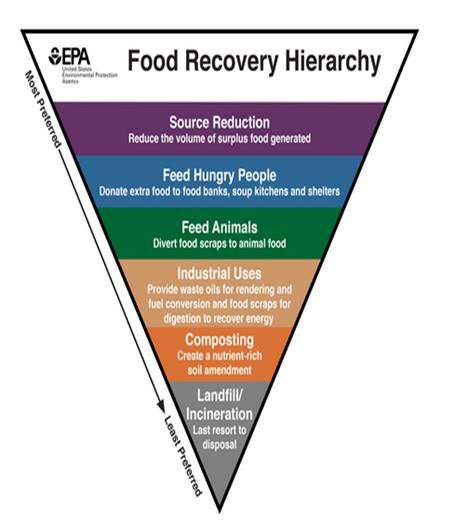
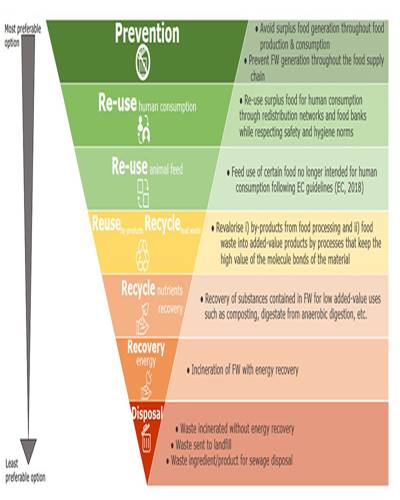
Source: NRDC (2019); Source: The European Commission’s Knowledge Centre for Bioeconomy (2021),
As is evident, both pyramids are based on CE parameters as they both consider that the best possible strategy begins with reducing the volume of surplus food generated (R0), adding that for the EU, this is to be done throughout food production and consumption and preventing FW throughout the food supply chain as wasted food is a waste of all the resources used to produce it.
As a second-best option, with the food that has already been produced, both the United States and the EU agree on the need to feed hungry people, donating extra food to food banks, soup kitchens, and shelters in the case of the United States. However, in the case of the EU this is achieved throughout redistribution networks and food banks, with the following important nuance: “while respecting safety and hygiene norms.” This seemingly logical addition can pose more problems than it solves. Of course, food must be donated in a good condition respecting safety and hygiene norms, but this last aspect can have important negative repercussions in terms of the number of food donations in the EU as it reinforces the primacy of food safety and thus increases possible liability due to any hypothetical negative consequences of its ingestion. Food that is not out of date, but maybe near or even passed its best before date, can be perfectly edible and safe, but it may be wasted during transport, for a lack of proper refrigeration or cold chain. It can even be stored at a food bank for too long or be cooked in an inadequate manner; however, this remote potential risk should not mean that food destruction is the best alternative for already-produced food. Liability in the EU becomes an important issue not only for food donors but also for the donation of services such as transportation or even for non-profit entities such as food banks, kitchen soups, shelters, or other anti-hunger organizations. The possibility of a remote risk of a negative effect caused by food should not be central in the matter as, in practice, it leads to food destruction, which is the final alternative in the food hierarchy. Providing food for animals, if possible, should be a third preferable option in the pyramid, but that step should only be taken whenever feeding hungry people is not possible.
Even rendering the food, whenever possible, for industrial uses is a better option than the one that too frequently occurs of FW. Of course, not all food products can be used for this purpose, but this applies to fats, when they are in a liquid state, and solid meat products that are particularly problematic to be disposed of in the sewer system or landfills as they cause the clogging of pipes and plumbing. Whenever these fats cannot be ingested by humans or animals they should be converted into other products, such as biofuels, soaps, cosmetics, etc. Girotto, Alibardi, and Cossu (2015) offer a series of solutions that may be implemented in the appropriate management of food waste, and prioritized in a similar manner to waste management hierarchy. Among the possible industrial uses, they also highlight biopolymers. Whenever this fourth alternative is not possible, the recovery of nutrients and fixation of carbon by composting is foreseen as a possible solution.
One of the most notable differences between public policies in the United States and in the EU is as follows. Whereas the first excludes donations done in good faith from liability, the second does not. This hinders food donations in the EU compared with the United States. Therefore, in the EU, to begin with, the obstacle of liability requires revision as it is the main cause of concern for many potential food donors such as food manufacturers, retailers, and wholesalers (Food Waste Reduction Alliance, 2012). If private entities want to donate adequate food products, acting in good faith, they need to be exempt from possible liability. This is a key feature for success as when private businesses or people want to donate, they cannot risk having possible adverse consequences, having acted with due diligence and in good faith. Administrative, civil, or criminal liability evidently acts as a deterrent to food donations, so to promote them, liability needs to be regulated in terms of the CE and the common good. Thus, liability is a barrier for food donations in the European Union, and so it would be advisable to have a clause, such as that which will be seen in the United States, at a supranational level. However, Member States can pass their own legislation on the matter.
In the United States, the 1996 Bill Emerson Good Samaritan Food Donation Act provides an exemption from liability to food donors and non-profit organizations that distribute food as long as they as they donate food that is apparently in a good state in “good faith” and do not act with intentional misconduct or gross negligence[19]. The FDIA, signed into law in December 2022, amends the 1996 Act to clarify the language and extend liability protection even when the donation takes place directly to those in need, allowing businesses to act even without intermediaries such as food banks or pantries. This measure, this paper argues, should be exported to other countries and supranational entities such as the EU.
Thus, in the case of the United States, this exemption from liability promotes donations. However, as we see from the available figures, nearly 40% of the food produced in the United States is wasted, which is an extremely high percentage, even though the obstacle of liability is removed in their case.
If the United States has adequately solved the problem of administrative, civil, or criminal possible liability, what is the problem? According to the Food Waste Reduction Alliance (2012), labelling food may be the issue as donors are required to adequately label it with information such as possible allergens and nutritional facts, and this is not always easy to do in a perfect manner. Therefore, the issue has moved to the following additional problem: the fear of facing liability due to donating mislabeled food, even if the mislabeling is not pertinent to food safety. This is now a major impediment to food donation in the United States (Food Waste Reduction Alliance, 2012). Although mislabeled food can only affect a very low percentage of people with health issues such as allergies or reactions, it becomes a major issue prohibiting food donations. The problem could potentially be solved by simply stating that the donated food is not edible by people with allergies or related problems, permitting food donation for the rest. To help people with these issues, other types of food that are 100% securely labelled can be given to them. In this manner, the potential reaction or allergy of a small amount of people does not prevent the donation to all the others. A general clause regarding potential liabilities regarding allergens appears therefore to be an easy solution. However, the measure needs to be undertaken as soon as possible to secure food donations in the rest of the cases.
Regarding the EU, a possible clause such as the following could help promote donations: "The good faith of the donor and donee is presumed. From the moment the donated thing is delivered to the donee, under the conditions required, the donor is released from all liability and shall not be civilly or criminally liable for damages caused by the donated item or by the risk thereof, unless fraud or fault attributable to the donor is proven, due to actions or omissions prior to the delivery of the thing."
In this manner, the food product donations could be more effectively promoted as a second-best option to achieving Target 12.3. Therefore, liability clauses should be revised so that food safety is not in question if the donation is not of food in an apparently bad situation and has been made in good faith. However, having considered the potential problems regarding allergens, a similar clause should be used to avoid the same problem.
Ultimately, if the hierarchy of food uses are summarized, even though it appears that in the USA FLW for energy is not contemplated, for the rest it can be concluded that both hierarchies coincide in the following chart, whereas the bottom one (landfill and incineration) is divided into two in the EU as the recovery of energy is always preferable to landfill and incineration without recovery of energy.
Chart 3
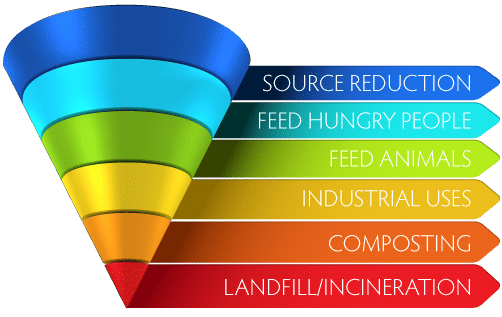
Source: EPA Food Recovery Hierarchy
Taxation can play an important role in achieving certain goals. On the one hand, public policies can use certain tax benefits to promote certain behaviors. On the other hand, specific taxes, such as environmental taxes, can be used to discourage others.
Regarding tax benefits, in personal or corporate income tax, the inclusion of benefits can help overcome several costs for food donors to non-lucrative organizations, such as SE Entities, helping them to achieve their social purpose and attain important social and environmental targets via the simple use of a circular measure to avoid waste. As these donations of food products to SE non-lucrative entities should not carry more costs to donors in addition to the cost of the donation in itself, such as the cost of storage or transport, particularly in cases where food requires refrigeration, a certain compensation is required, and this can easily be achieved through proper tax benefits. It should be remembered that transport, particularly in the case of refrigerated food, can pose very important costs. This cost cannot be placed on food donors as it would obviously be economically an important deterrent, and it cannot be placed on non-lucrative entities as they do not always have the means to achieve that end. Therefore, a sufficiently important tax benefit is required for donors to compensate these costs if they are placed on them; alternatively, more actors need to become involved, such as transportation or food delivery entities that donate their services. In any case, public means should be used for this purpose, either directly or indirectly, to promote donations.
In this sense, the possible donation of services, not always contemplated in legislation, also needs to be remembered regarding the tax benefit. For instance, a transportation company and food delivery company may want to join forces against FLW, providing transportation services, to enjoy the possible tax benefits. These services are not always considered regarding donations; therefore, a legislative effort should be undertaken to include them.
In this manner, public entities need to legislate to promote this public–private collaboration to achieve the target. The State, region, or municipality alone cannot achieve this and if it requires food donors and non-lucrative entities to help achieve the target, then the first step must be setting the right public policies, among them fiscal policies, to achieve the goal. Tax incentives can be an important factor as they make food donations more cost effective and economically beneficial for entities. These forms of benefits already exist both in the United States and some countries in the EU. A comparative analysis now follows to establish if they have been properly devised or may sometimes require a correction.
6.1. Tax benefits for food donations in Corporate Income Tax at a federal level in the United States
Generally speaking, at a federal level, the most common forms of business in the United States are corporations, partnerships, sole proprietorships, and S corporations. For all these types of legal forms, different legal and tax considerations play a role in deciding which one to select as there is a different choice of tax for each of these legal forms. Thus, before 2015 there was no “one size fits all” benefits in the US tax system regarding the possible donations of food products to hunger relief organizations (i.e., food banks, soup kitchens, etc.) to help those in need. However, after the passing of the Protecting Americans from Tax Hikes (PATH) Act in December 2015, the temporary and limited benefits that existed were not only made permanent but were also extended to all forms of entities (C-corporations, S-corporations, limited liability corporations [LLCs], partnerships, and sole proprietorships). Therefore, from 2015, all these businesses are eligible for an enhanced tax deduction for food donations that meet certain requirements. Whenever those requirements are not met, the entity can still claim a general tax deduction in the amount of the property’s basis.
The actual tax benefit is in 26 U.S.C. § 170(3)(C), which comprises a special rule for contributions of food inventory which allows as a deduction any charitable contribution, and in the case of a charitable contribution of food from any trade or business of the taxpayer, the deduction is limited to apparently wholesome food, for obvious reasons. This section 170 (e) of the Internal Revenue Code (IRC) offers enhanced tax deductions to those qualified entities so they can deduct the cost to produce the food and half the difference between the cost and full fair market value of the donated food. This is a permanent benefit following the PATH Act, which extended it in time and legal forms to include C-corps, S-corps, LLC, partnerships, and sole proprietorships.
However, even though the benefits may appear the same, this is not quite the case due to the different tax caps. Therefore, a distinction is required depending on the form the entity takes: C corporations, sole proprietorships, partnerships, subchapter S, and LLCs.
The usual corporations in the US system are C-Corporations, regulated under Subchapter C of the IRC. In the last few years, there have been significant changes made to income tax to corporations by the Tax Cuts and Jobs Act, certain post-COVID-19 provisions, and the Inflation Reduction Act (IRA) of 2022[20]. At a federal level, C-corps pay federal corporate income taxes, levied at a 21% rate. However, States can levy an additional percentage that varies, ranging from 2.5% in North Carolina to 11.5% in New Jersey. There are six States (Ohio, Nevada, South Dakota, Texas, Washington, and Wyoming) with no state corporate income tax.
As for the general benefit for C-corps, whenever they donate inventory, they can claim a tax deduction in the amount of the property’s basis, which is usually its cost to the business, as is the case for any other legal type of business. However, their tax cap is lower than other legal forms as C-corporations generally cannot deduct more than 10% of their taxable income for the year.
Regarding the enhanced tax deduction, C corps can deduct the lesser of two amounts: (a) twice the basis value of the donated food or (b) the basis value of the donated food plus one-half of the food’s expected profit margin (if the food were sold at its fair market value). In this case, the enhanced tax deduction, the tax cap benefits C-corps as it increases from the general 10% to a 15%.
Businesses that choose any other form of organization (not corporations) are, in general, not subject to the corporate income tax. Instead, the income of these businesses passes through to their owners and is taxed according to individual income tax rates, which are currently higher. Examples of these alternative “pass-through” forms of organization include sole proprietorships, partnerships, subchapter S corporations, and LLCs. Pass-through businesses do not have an entity-level tax so their owners must include their allocated share of the businesses’ profits in their taxable income under their individual income tax. Cooperatives can take these forms, so they can be passed through.
In the case of these entities, a general benefit whenever they are donating inventory is that they can claim a tax deduction in the amount of the property’s basis, which is usually its cost to the business. In this manner, the possible use of the more undetermined and difficult fair market value, which is usually higher, is avoided. Businesses other than C-corporations (S-corporations, sole proprietorships, and some LLCs) have a higher tax cap as they can deduct up to 30% of the business’ total taxable income each year. This tax cap is much higher than the one for C-corporations, so there is a big difference in practice with the general deduction.
Regarding the enhanced tax deduction, where the entity can deduct the lesser of two amounts: (a) twice the basis value of the donated food or (b) the basis value of the donated food plus one-half of the food’s expected profit margin (if the food were sold at its fair market value), there is no difference in tax caps as the aggregate amount of such contributions for any taxable year that may be taken into account shall not exceed 15% of taxable income. Thus, in this case, the tax cap increases for C-corporations (from 10% to a 15%) whereas it falls for all other sorts of businesses (from 30% to 15%).
6.2. Tax benefits for food donations in the EU regarding Corporate Income Tax
In the EU, direct taxation belongs to Member States. The Treaty on the European Union (TEU) does not grant explicit legislative powers at EU level, but Article 115 of the Treaty on the Functioning of the European Union (TFEU) does authorize the adoption of directives for the approximation of the laws, regulations and administrative provisions of the Member States that directly affect the internal market, by unanimity and in accordance with the consultation procedure. In this manner, the Member States may adopt instruments, such as directives, in the field of indirect taxation or even in certain matters that may have an impact on the internal market, such as corporate income tax. However, the unanimity requirement is a serious handicap for doing so.
In this manner, Corporate Income Tax already has a certain partial harmonization through several Community Directives, sometimes directly aimed at taxation, as is the case of the Directive on mergers (Directive 2009/133/EC), the Directive on parent companies and subsidiaries (Directive 2011/96/EU), and others. This is also applicable to the field of Corporate Income Tax, as well as being directed at harmful practices, as in the case of the Arbitration Procedure Convention (90/436/EEC) and, more recently, Council Directive (EU) 2016/1164, of 12 July 2016, which established a framework to fight hybrid asymmetries that was subsequently extended by Council Directive (EU) 2017/952. However, there is no such instrument regarding the possible benefits of food donations. Therefore, it is a competence of Member States.
There is a common strategy in the EU, the Farm to Fork Strategy, under the European Green Deal. This is an action plan that includes a commitment and a framework, but cannot consider tax benefits in Corporate Income Tax as it is for Member States to decide if they grant them and the manner in which they do so. It is actually a CE measure, the Revised Waste Framework Directive (2018); the legally binding instrument that requires Member States to monitor and reduce food waste at each stage of the supply chain. This is a framework that requires Member States to commit to the goal, preparing food waste prevention programs, encouraging food donation, and prioritizing human use of food over animal feed an in a general manner, providing incentives for the application of the waste hierarchy. Among these incentives we can find tax incentives, but it is up to Member States if they apply them and how.
Regarding the EU Guidelines on Food donations, they are important guidelines that clarify and attempt to harmonize a number of matters. However, they cannot be considered a legally binding instrument. Moreover, in certain Member States such as Spain or Belgium, different regimes might exist for different regions with taxing power. This is the case of the Basque Country (which includes the regimes of Gipuzkoa, Biscay, and Araba); Navarra in the case of Spain and of the French; and the Wallon or Flanders regions in Belgium. Therefore, uniformity regarding direct taxes such as Personal and Corporate Income Tax is not expected, even within certain Member States. Regarding tax incentives in Corporate Income Tax, they exist in a number of Member States following their own rules.
In France, that has a very advanced general legislation to fight FLW, even though the benefit may appear important at a first glace (a tax deduction of 60% of the value of donated food) it is not, because of the very low cap of 0.5% of the company’s turnover that could be used in the following five years.
In Spain, tax benefits for both Personal and Corporate Income Tax regarding donations can be fairly important. Even though there are no specific provisions for food donations, they can be included in the general concept of donation of products. Corporate Income Tax and Personal Income Tax on the Law amending Law 49/2002, of December 23, 2002, on the tax regime for non-profit entities and tax incentives for patronage, establish that in the case of a donation of products to a foundation or a public utility entity, a deduction of a 40% of the value of the donation can be applied to the tax liability, after its recent amendment. This deduction can be up to 50% in cases where a certain regularity is appreciated, for having made donations for an amount equal to or greater than those of the previous year to the same entity in the two preceding years. As for the tax caps in Spain, they are limited to 10% of the taxable base, and the surplus can be deducted during the following 10 years for Corporate Income Tax. However, this very generous increase in the amount of the deduction may become nothing if a systematic approach is taken together with the new VAT reform.
Portugal has an enhanced tax deduction, meaning donors can deduct up to 140% of the value of the food at the time of donation, provided that the food will be used for a social purpose (such as supplying food banks or pantries) and provided there is a cap of up to 8/1000 of the donor’s turnover whenever the food is used for the general interest.
In Germany, according to the Income Tax Act (EStG §10b), which is not particularly concerned with food donations but to a form of donations in which food donations can be included, and also the Corporate Tax Act (Section 9), donations in cash or in kind are tax-deductible expenses, within the limit of 20% of corporate income or 0.4% of the company’s total sales, wages, and salaries spent in the year[21].
As is evident from the above, there are very significant differences in Corporate Income Tax as it is a matter regulated by the States, which do not follow a framework.
6.3. Tax measures to promote food donations regarding VAT
VAT can also be a tax with important implications for food donations as it can present an extremely serious problem for food donors. This is because there is no final consumer paying for VAT in the case of donations to SE non-lucrative entities, or else these last entities can be considered final consumers who therefore have to pay the VAT. Consequently, in the case of donations, food donors sometimes need to pay for the VAT of the donated products themselves or pass it to the non-profit entities acting as recipients and end consumers. Therefore, VAT can be regarded as an obstacle in cases where the market value of the donation is considered as the taxable base for food donation. VAT is not an issue in the United States as it does not apply to food donations. However, it is still an issue in certain EU countries.
In this sense, in the EU, articles 16 and 74 of the VAT Directive, which may have solved the problem, are interpreted by some Member States as being an obstacle as food donations have to pay VAT according to the value of the donation. In some other Member States, the market value is considered to be zero, thus avoiding the problem, but maybe posing a problem as regards the Corporate Income Tax deduction, as its base may also be considered to be zero.
It has been noted that the EU cannot do much at an EU level regarding Personal or Corporate Income Tax as this is the competence of Member States. However, VAT is an indirect tax and the EU can have a leading harmonizing role in this type of taxes. However, regulation at a EU level, which has adapted the rules applicable to donations of products (Articles 16 and 74 of the VAT Directive) that can help promote the donation of surplus food for charitable purposes, has not been interpreted in a similar manner in different Member States, even though the EU VAT Committee issued guidelines to ensure a uniform interpretation[22].
The section point in question is as follows:“[…] the taxable amount shall be the purchase price of the goods (or of similar goods or, in the absence of a purchase price, the cost price of the goods) donated, adjusted to the state of those goods at the time when the donation takes place.” Thus, in several Member States, they interpret that the value of the donated food, in terms of its taxable base, when it is close to its ‘best before’ or ‘use by’ date, is very small or even zero. However, other Member States understand that this value needs to be considered either in relation to the fair market value or even the cost value, and must be determined in each case, charging VAT.
The guidelines are not a compulsory legal instrument but rather a good faith instrument to promote food donations. Regarding these measures, for instance, Spain has recently adopted new waste legislation for a CE that changes its previous interpretation regarding VAT for all product donations, not only food donations, which now have a zero taxable base and a zero rate whenever these product donations are made to non-lucrative entities, in order for them to fulfil their social purpose[23]. Such a measure is in line with the CE and the proposed Target 12.3 of the 2030 Agenda. Therefore, this form of tax measure should be used to promote food donations to non-lucrative entities. In addition, this same Law 7/2022 on Waste and Contaminated Soil for the Circular Economy introduces an important modification referring to the VAT of donated products as, whenever they are donated to non-lucrative entities in order for them to fulfil their social purpose, the tax rate also becomes zero. This reiterative benefit may be considered a handicap as regards the Corporate Income Tax deduction.
Greece, France, Hungary, Belgium[24], Germany, Italy, and Poland also have legislation that consider that the rate at which the donation of products requires taxing is a zero rate or that these donations can be considered equivalent to a total destruction of the product for VAT purposes. Spain has just added a new paragraph four to Article 91 of the VAT Law, whereby a 0 rate is to be applied to supplies of goods made as donations to non-profit entities provided that they are used by the same for purposes of general interest. Therefore, in the case of these countries, VAT is not an issue as the zero rate is the best possible solution to promote food product donations.
However, even if rare, caps can also exist regarding VAT, which is the case in Croatia, where, when food is donated to a registered charity, it can have a zero rate but be within the limit of 2% of the donor’s income[25].
As is evident, even though there is the potential for a certain uniformity regarding VAT, this is prevented by some of the different interpretations of the articles regarding the EU VAT Directive.
· Target 12.3 of the 2030 Agenda presents a significant challenge as, on the one hand, it has important repercussions for a number of SDGs and, on the other, its achievement requires immediate action, proper public policies, and collaboration between private and public entities in the form of a mission. In this respect, there is an urgent need for nations to have national strategies to reduce FLW, aligning public policies with the private sector, producers, and consumers.
· Reducing FLW is a target that falls within the Circular Economy, as there is a need to reduce input and waste. Therefore, CE hierarchy and solutions need to be followed to achieve it in the best possible manner. Both the United States and the EU coincide in this as their food hierarchy can be considered to have the following CE patterns:
- first comes source reduction due to overproduction;
- with the food already produced, we should feed hungry people, then animals, and then use FLW for different industrial uses;
- then comes composting, landfilling, and incineration, with the recovery of energy if possible.
However, no step should be embarked upon until all possible measures have been taken to fulfil the previous step. Therefore, with the food that has already been produced, the best possible solution is the donation of food to those in need, preferably through SE entities, such as food banks and soup kitchens or other non-profit entities.
· We can only reduce FLW if public authorities, starting at the highest possible level, set fair and adequate rules which promote food donation through public policies. Similarly, SE entities such as food banks and soup kitchens can only fulfil their social goals if private entities have adequate corporate social responsibility (CSR), using a FLW strategy. Finally, we can only achieve a target that gets us closer to achieving the other SDGs if we overcome the existing barriers and set the right measures to promote food donations, via the collaboration of all.
· Among the public measures, this paper compares liability measures and tax measures as these are of the upmost importance. The United States appears to have solved the problem as regards liability, but there are still certain barriers, such as possible food mislabeling in the case of allergies. The EU has yet to do so at the EU level, having always focused on hygiene and food safety, but this should not be incompatible with the goals when we consider perfect food products that are not past their due date.
· Regarding tax measures, the paper’s findings show that in the United States, there are important benefits regarding food donation, but a widespread problem caused by tax laws that include tax benefits is tax caps or tax limits, which ultimately diminish the possible tax benefits. In the United States, regarding Income Tax, this is different for C-corps and other forms of businesses. In the EU, there is no competence at an EU level for income tax, so each Member State follows different policies, tax caps also being a frequent issue. Moreover, in the EU, even though there is a competence and food donations are actually regulated in a Directive, followed by a Code of Conduct, their interpretation of VAT rules on food donations by Member States also varies and can sometimes present a very serious obstacle to food donations. Therefore, these should also be revised, considering the importance of the target and the need for food donors and SE entities to be able to accomplish their target, creating a sustainable food system. Ultimately, donors’ efforts to avoid FLW make a significant difference, not only on the recipients but also on the environment.
The author declares no conflict of interest.
This paper has been funded by the University of the Basque Country group GIU 21/005 (La incidencia en el Sistema fiscal vasco del derecho supra-nacional y de la Agenda 2030) and Euskampus Missions 2.0 (SOFIA Project).
Alnoor, Bajželj, B., Quested, T. E., Röös, E., & Swannell, R. P. (2020). The role of reducing food waste for resilient food systems. Ecosystem Services, 45.
Boulding, K. (1966). The economics of the coming spaceship earth. In H Jarret (Ed.), Environmental quality in a growing economy (pp. 3–14) Resources for the Future/Johns Hopkins University Press.
Broad Leib, E. (May 25, 2016). Food waste, from field to table. https://docs.house.gov/meetings/AG/AG00/20160525/104972/HHRG-114-AG00-Wstate-BroadLeibE-20160525.pdf.
Cattaneo, A., Sánchez, M. V., Torero V., & Vos, R. (2021). Reducing food loss and waste: Five challenges for policy and research. Food Policy, 98, 1–9. https://doi.org/10.1016/j.foodpol.2020.101974.
Chaves Avila, R. & Monzon Campos, J. L. (2018). La economía social ante los paradigmas económicos emergentes: Innovación social, economía colaborativa, economía circular, responsabilidad social empresarial, economía del bien común, empresa social y economía solidaria. Revista del CIRIEC-España Economía Pública Social y Cooperativa, 93.
Cramer, J. (2014). Milieu. Amsterdam University Press.
Drabik, D., De Gorter, H., & Reynolds, C. (2019). Conceptual and empirical framework to analyze the economics of consumer food waste. Resources, Conservation and Recycling, 149, 500–509.
EAT-Lancet (2019). Food in the anthropocene. https://eatforum.org/content/uploads/2019/07/EAT-Lancet_Commission_Summary_Report.pdf.
European Commission (2020). A map of Social Enterprises and their ecosystems in Europe, Comparative synthesis report 2020. https://ec.europa.eu/social/main.jsp?catId=738&langId=en&pubId=8274.
European Commission (2020). A new Circular Economy Action Plan For a cleaner and more competitive Europe, 11-3-2020. https://environment.ec.europa.eu/strategy/circular-economy-action-plan_en.
European Commission (2021). Scenarios towards co-creation of a transition pathway for a more resilient, sustainable and digital Proximity and Social Economy industrial ecosystem. https://single-market-economy.ec.europa.eu/consultations/scenarios-towards-co-creation-transition-pathway-resilient-innovative-sustainable-and-digital_en.
European Commission, directorate-general for health and food safety (2018). Market study on date marking and other information provided on food labels and food waste prevention: final report, EC Publications Office, https://food.ec.europa.eu/system/files/2018-07/fw_lib_srp_date-marking.pdf.
EU Fusions (2016). Estimates of European food waste levels. https://www.eu-fusions.org/phocadownload/Publications/Estimates%20of%20European%20food%20waste%20levels.pdf.
EUROSTAT (2022) Sustainable development in the European Union — 2022 monitoring report on progress towards the SDGs in an EU context.
FAO (2019). The state of the world's biodiversity for food and agriculture. http://www.fao.org/3/CA3129EN/CA3129EN.pdf.
FAO (2022). The State of Food Security and nutrition in the world 2022: repurposing food and agricultural policies to make healthy diets more affordable. https://www.fao.org/3/cc0639en/cc0639en.pdf.
FAO, FIDA, OMS, PMA y UNICEF (2022). La Seguridad Alimentaria y la nutrición en el Mundo, FAO, Rome. https://www.fao.org/3/cc0640es/cc0640es.pdf.
Fernández-Guadaño, J., & Montes Diez, R. (2023). Social Entrepreneurship Impact in Ten EU Countries with Supportive Regulations. Journal of the Knowledge Economy, 1-18. https://doi.org/10.1007/s13132-023- 01513-4
Flanagan, K., Robertson, K. & Hanson, C. (2019). Reducing food loss and waste. https://web.archive.org/web/20211117130643id_/https://wriorg.s3.amazonaws.com/s3fs-public/reducing-food-loss-waste-global-action-agenda_0.pdf.
Food Waste Reduction Alliance (2012). Analysis of U.S. Food Waste Among Food Manufacturers, Retailers, and Restaurants, 13, 16.
Gustavsson, J., Cederberg, C., Sonesson, U., (2011), Global Food Losses and Food Waste, Save Food Congress, Dusseldorf, 16 may 2011.
IPBES (2019). Global assessment report on biodiversity and ecosystem services. https://ipbes.net/global-assessment.
IPCC (2019) Special report on climate change and land. https://www.ipcc.ch/srccl/.
Krugman, P. (2023). Cooperating for a better future. CIRIEC España, Revista de Economía Pública, Social y Cooperativa, 107, 5–14. https://doi.org/10.7203/CIRIEC-E.107.26369.
Lipinski, B., Hanson, C., Lomax, J., Kitinoja, L., Waite, R. & Searchinger, T. (2013). Reducing food Loss and Waste Working Paper. World Resources Institute. https://files.wri.org/d8/s3fs-public/reducing_food_loss_and_waste.pdf.
Manfredi Sánchez, J. L. (2021). Planificación estratégica para el Plan de Recuperación, Transformación y Resiliencia. In La Gestión de los Fondos Next Generation Claves de la Revolución administrativa, Wolters Kluwer.
Martin-Rios, C., Rogenhofer, J., & Sandoval Alvarado, M. (2023). The true cost of food waste: Tackling the managerial challenges of the food supply chain. Trends in Food Science & Technology, 131, 190–195. https://doi.org/10.1016/j.tifs.2022.12.005.
Mazzucato, M. (2014). The entreprenurial state. Anthem Press.
Mazzucato, M. (2023). Inclusive and sustainable growth. A mission-driven multi-stakeholder approach. CIRIEC-España, Revista de Economía Pública, Social y Cooperativa, 107, 27–35. https://doi.org/10.7203/CIRIEC-E.107.26371.
Mugica, Y. Hover, D. & Terra, R. (February 11, 2019). Tackling Food Waste in Cities: A Policy and Program Toolkit. https://www.nrdc.org/resources/tackling-food-waste-cities-policy-and-program-toolkit.
Murray, J., & Hansen, J. (2013). Peak oil and energy independence: Myth and reality. EOS, 94(28).
NRDC (n.d.) Food Matters. https://www.nrdc.org/food-matters.
Parfitt, J. Barthel, M. and ,Macnaughton, S. (2010). Food waste within food supply chains: quantification and potential for change to 2050, https://royalsocietypublishing.org/doi/full/10.1098/rstb.2010.0126.
Pearce, D. & Turner, K. (1995), Economía de los Recursos Naturales y del Medio Ambiente, traducción al español por parte del Colegio de Economistas de Madrid, ed. Celeste Madrid.
Philippidis G., Sartori, M., Ferrari, E., & M'barek (2019). Waste not, want not: A bio-economic impact assessment of household food waste reductions in the EU. Resources, Conservation and Recycling, 146, 514-522. https://doi.org/10.1016/j.resconrec.2019.04.016.
Östergren, K. et al. (2013). Transparency for sustainability in the food chain: Challenges and research needs EFFoST Critical Reviews, 2. https://doi.org/10.1016/B978-0-12-417195-4.00004-7.
Rixon, D., & Duguid, F. (2022). Cooperative leaders need to lead the way on Global and Local SDG adoption. Emerald Publishing.
Santos, N., Borgomeo, E. H., & Vesselina, B. L. (2022). Investing in Food loss and waste: what is in it for Development Banks. FAO, Rome.
Sastre Sanz, S. (2019). Instrumentos fiscales para una Economía Circular en España, Documentos de Trabajo 10/2019, 4.
Tomás Carpi, J. A. (2008). The prospects for the social economy in a changing world. CIRIEC-España, 62.
UN Environment, International Resources Panel, Global Resources Outlook (2019). Natural Resources for the Future We Want, Implications for Business Leaders, Geneve. https://www.resourcepanel.org/reports/global-resources-outlook.
U.S. Environmental Protection Agency, The Food Recovery Hierarchy. https://www.epa.gov/sustainable-management-food/food-recovery-hierarchy.
Vaillancourt, Y. (2009). Social economy in the co-construction of public policy Annals of Public and Cooperative Economics, 80(2)
Wolf, R. (2005). Definitions of public policy analysis: resources for promoting objectivity and balance in consolidated democracies. Policy Studies Journal, 33(2).
[1] At the heart of the EU Green Deal.
[2] We here use the concept of supranational as an entity that is above the scope of national governments and institutions and acts independently of them. In this sense both the USA and the EU can be considered to be supranational as they can act independently of Member States in areas where they have the competence to do so.
[3] See the report by the NRDC (2019): “Up to 40 percent of food in the United States is wasted, contributing to extensive environmental, economic, and societal impacts. But solutions to the enormous challenge of food waste can create equally extensive benefits, particularly at the local level. By reducing the amount of food that is thrown out, cities can stabilize their waste management costs and make progress toward climate and sustainability goals. By rescuing surplus food, municipalities can address food gaps in local communities. And by recycling food scraps, cities can minimize what goes into landfills and incinerators”.
See also: Mugica, Y., Hover, D. and Terra, R. (2019): “The United States has an extraordinary food waste problem: up to 40 percent of all food in the country is not eaten. At the same time, 41 million Americans face food insecurity. Tackling food waste by reducing food waste, rescuing surplus food, and recycling food scraps would reduce greenhouse gas emissions and put food on the tables of Americans across the country—and cities are uniquely positioned to help solve this problem.”
Also, in p. 5 of the toolkit guide: “Up to 40 percent of all food in the United States is wasted. Producing food that we don’t consume also swallows up roughly 20 percent of America’s cropland, fertilizers, and agricultural water and generates greenhouse gas emissions equivalent to 37 million passenger vehicles each year. Yet, 41 million Americans lack consistent access to adequate and nutritious food.”
The estimation for the EU is based on EU Fusions (2016).
[4] In 2019, several scientific reports, from EAT-Lancet (2019) the FAO (2019) and the IPBES and IPCC (2019), all evidenced the strains food put on nature, showing how we need to transform how we produce, distribute, and consume food.
[5] As Mazzucato Mariana (2014) explains: the mission "consists of the orientation of public activities (investments, prices, administrative law, management controls, regulatory laboratories) and private activities (creativity, social initiative, private financing, third sector, entrepreneurs) for the achievement of a transforming project with an innovative profile. Mission planning is inspirational and ambitious, because it aims at changing public policies to achieve social impact. The mission is a flexible instrument, it is not an end in itself."
[6] Regarding the USA, 40% of the food produced in this country becomes waste. According to Broad Leib E. (May 25, 2016). Food waste, from field to table, this results in 62.5 million tons of wasted food each year, and this figure has been rising for several decades. See https://docs.house.gov/meetings/AG/AG00/20160525/104972/HHRG-114-AG00-Wstate-BroadLeibE-20160525.pdf.
[7] The water footprint amounts to 250 billion cubic meters of water per year and the carbon footprint3.3 billion tons of CO2 per year. 1.82 million hectares are deforested.
[8] See https://www.epa.gov/facts-and-figures-about-materials-waste-and-recycling/national-overview-facts-and-figures-materials.
[9] For instance, SDG 2, zero hunger, although it is also considered essential for the achievement of others, such as SDG3, health and well-being; SDG5, quality education; SDG10, reducing inequalities; SDG12, responsible production and consumption; SDG13, climate action; SDG14, underwater life (as it affects fish); and SDG15, terrestrial life and ecosystems.
[10] LLEI 3/2020, de l'11 de març, de prevenció de les pèrdues i el malbaratament alimentaris in Catalonia.
[11] Parfitt, J. Barthel, M. and , Macnaughton, S. (2010), “Food waste within food supply chains: quantification and potential for change to 2050”, https://royalsocietypublishing.org/doi/full/10.1098/rstb.2010.0126.
[12] Gustavsson, J., Cederberg, C., Sonesson, U., (2011), Global Food Losses and Food Waste, Save Food Congress, Dusseldorf, 16 may 2011.
[13] To this must be added the observations made by Flanagan, Robertson and Hanson (2019), who understand that, although exact data are not available, there is also a significant loss of food in the phases prior to harvest, capture, or slaughter; and in the course of harvest, capture, or slaughter, that is difficult to incorporate into statistics.
[14] The food wasted would be sufficient to feed 2,000,000,000 people. The water footprint is estimated at approximately 250,000 million cubic meters of water per year; as for the carbon footprint, it is approximately 3.3 billion tons of CO2 per year. Regarding deforestation, 1.82 million hectares are deforested yearly pertaining to FLW.
[15] In this regard, it is worth noting the work of Bajželj, B., Quested, T. E., Röös, E., and Swannell, R. P. , The role of reducing food waste for resilient food systems. Ecosystem Services, 45, 2020. They understand that FL and FW damage the ecosystem and its resilience in the long term as it is a synergistic relationship. These authors, in line with CE parameters, consider that over-production in particular should be avoided. They would therefore go to the root of the problem, which can be classified as R0, “refuse,” in terms of the CE.
[16] Regulation (EC) No 178/2002 of the European Parliament and of the Council.
[17] On food banks, see the work of Santos, N., Borgomeo, E., Haralampieva, V., & Baumann, L. (2022).
[18] Regarding waste, this organization also works with others such as the U.S. Composting Council, the World Wildlife Fund, and ReFED, which all work on specific aspects of food waste.
[19] 42 U.S.C. §
1791. (Bill Emerson Good Samaritan Food Donation Act) (c)(1) “A person or
gleaner shall not be subject to civil or criminal liability arising from the nature,
age, packaging, or condition of apparently wholesome food or an apparently fit
grocery product that the person or gleaner donates in good faith to a nonprofit
organization for ultimate distribution to needy individuals...
(c)(2) A nonprofit organization shall not be subject to civil or criminal
liability arising from the nature, age, packaging, or condition of apparently
wholesome food or an apparently fit grocery product that the nonprofit
organization received as a donation in good faith from a person or gleaner for
ultimate distribution to needy individuals....”
[20] Public Law No. 117-169.
[21] Einkommensteuergesetz 10b Steuerbegünstigte Zwecke.
[22] European Commission, Directorate-General for Health and Food Safety, Food redistribution in the EU : mapping and analysis of existing regulatory and policy measures impacting food redistribution from EU Member States : annexes, Publications Office, 2020, https://data.europa.eu/doi/10.2875/873698.
[23] The 3rd F.D. of Law 7/2022 on Waste and Contaminated Soil for the Circular Economy introduces an important modification referring to the VAT of "products," among which "food products" deserves to be highlighted for the purposes at hand as it is fully applicable.
[24] See the following VAT decisions: VAT Decision n° E.T.127.958 and VAT Decision °E.T.124.417
[25] VAT Ordinance (OG No79/13, 85/13, 160/13, 35/14, 157/14, 130/15, 1/17, 41/17, 128/17 and 1/19.